DeformGen: Dynamics-Based Topology Augmentation for Deformable Manipulation Policy Learning

Zili Lin1,2, Wenyao Zhang1,2,†, Yuyang Zhang1,2, Zekun Qi3, Junyan Lin2,4, Hanxin Zhu5,6, Jiaolong Yang, Zhibo Chen5,6, Yao Mu1, Xiaokang Yang1, Xin Jin2,6, Wenjun Zeng2,✉
1Shanghai Jiao Tong University 2Eastern Institute of Technology, Ningbo 3Tsinghua University 4The Hong Kong Polytechnic University 5University of Science and Technology of China 6Zhongguancun Academy
Project Lead · Corresponding author
DeformGen overview teaser

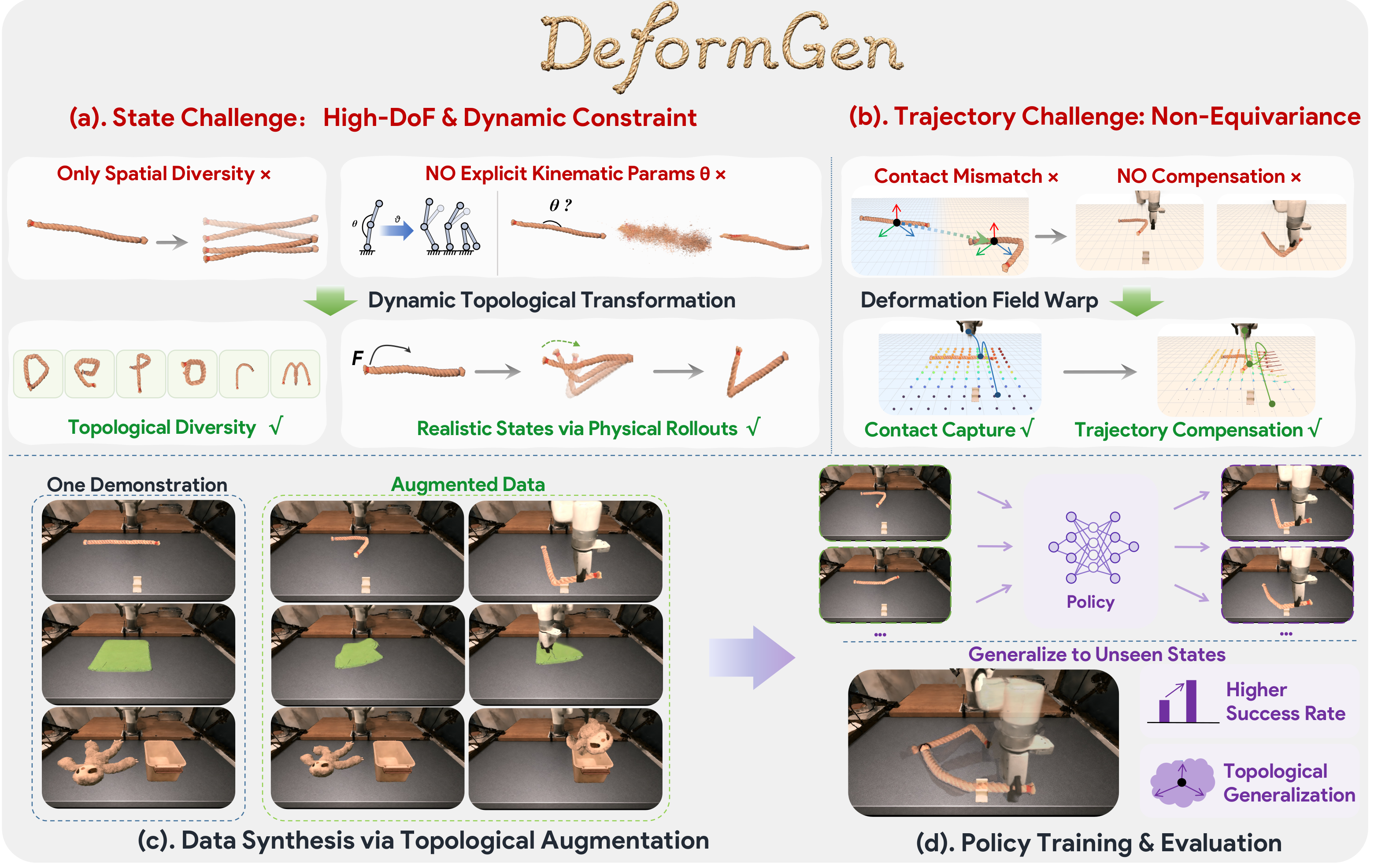
DeformGen overcomes the state-space and trajectory-transfer limits of rigid augmentation by pairing dynamics-based topology transformation with deformation-field warping, synthesizing diverse demonstrations from a single source demonstration for better generalization to unseen deformable states.

Abstract

Demonstration augmentation is proposed for cost-efficient data acquisition, but existing methods are fundamentally limited in deformable manipulation due to two challenges: (1) the state space is high-dimensional with physics-induced constraints, making valid configurations impossible to reach via low-dimensional pose perturbations; and (2) trajectory transfer is non-equivariant, as material points no longer move rigidly together under deformation.

We present DeformGen, a dynamics-based augmentation framework that achieves topological diversity for deformable objects. For the state challenge, DeformGen expands the valid state distribution by applying localized physical disturbances and forward-simulating the dynamics to obtain topology-coherent, physically plausible deformable states.

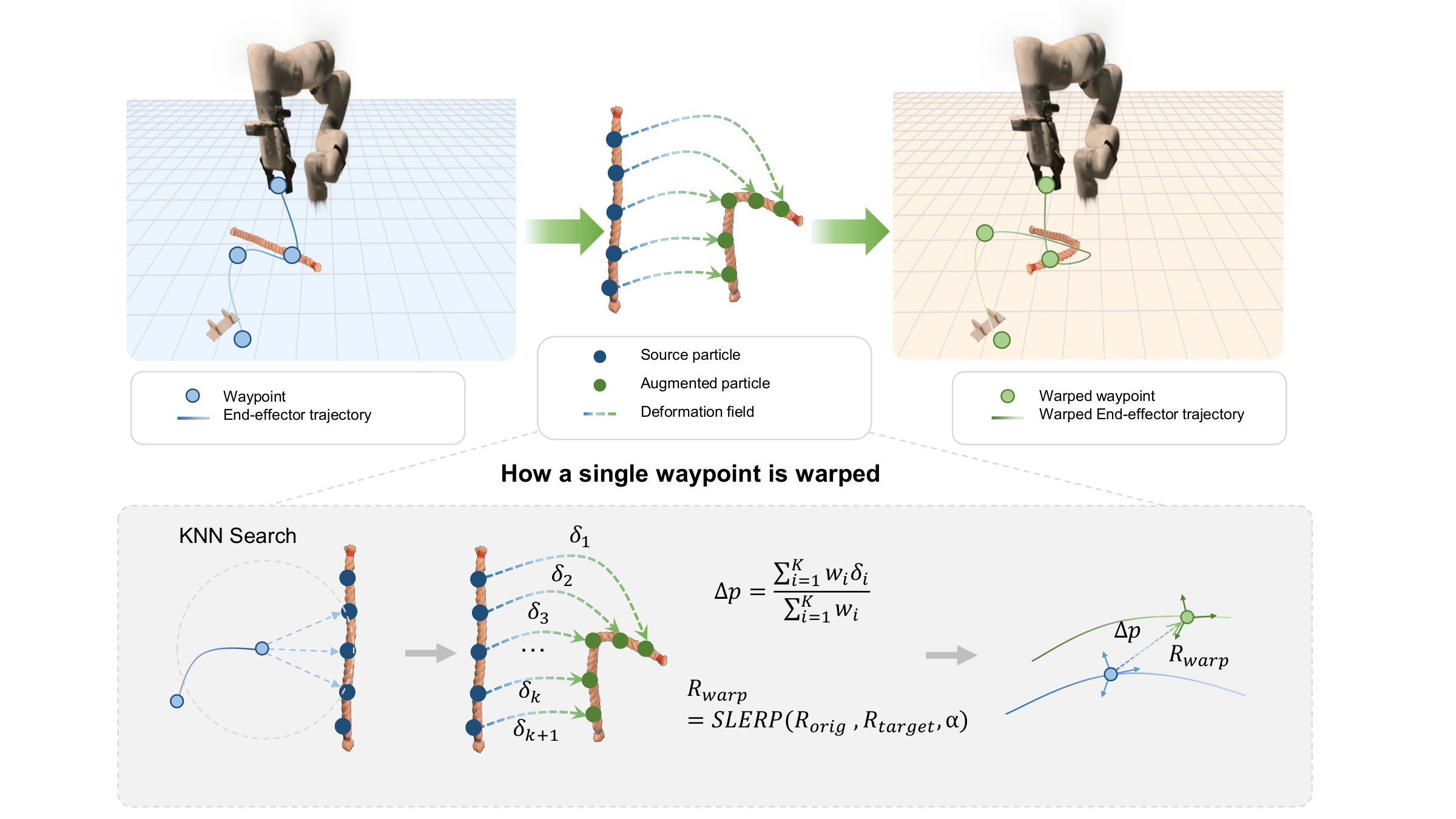
For the trajectory challenge, DeformGen transfers source manipulation trajectories via deformation-field warping, which lifts per-particle displacements into a continuous spatial function to adapt the end-effector trajectory consistently with the deformed geometry.

In this way, our method jointly augments the state distribution and its associated manipulation behavior. Experiments on high-fidelity deformable manipulation benchmarks show that DeformGen generally improves policy learning compared with training on the original demonstrations alone and with rigid-style augmentation baselines.
Method

DeformGen first expands the physically plausible state distribution, then synthesizes manipulation trajectories that remain consistent with each deformed geometry.

1

Dynamics-Based State Augmentation

The objective is to generate diverse object configurations for the same task while staying inside the physically plausible subspace of the deformable object. Rather than perturbing a low-dimensional object pose or applying arbitrary per-particle noise, DeformGen starts from a valid state, applies localized physical disturbances, and forward-simulates the calibrated dynamics so the simulator continuously enforces material and contact constraints.

Dynamics-based state augmentation
Dynamics-based topological augmentation produces physically plausible and diverse deformable states.
2

Deformation-Field Trajectory Warping

The objective is to synthesize valid manipulation trajectories for unseen object configurations. DeformGen constructs a closed-form deformation field from per-particle displacements between source and deformed states. For each waypoint, K-nearest-neighbor particle displacements are interpolated to obtain the position offset, while a local Jacobian estimates the orientation update. The resulting approach, grasp, and manipulation phases are replayed to retain only executable trajectories.

Deformation-field trajectory warping
Deformation-field warping adapts both grasp pose and manipulation path to the new geometry.

Results

Success rate (%) on held-out deformable-object states. DG denotes the full DeformGen pipeline.

ACT59.00%

DG average success

Diffusion Policy37.33%

DG average success

SmolVLA56.50%

DG average success

π056.67%

DG average success

Policy1 SourceSMG*DG*DG
ACT1.3348.1746.8359.00
Diffusion Policy2.3338.0041.0037.33
SmolVLA2.5040.3355.0056.50
π02.3327.8351.6756.67
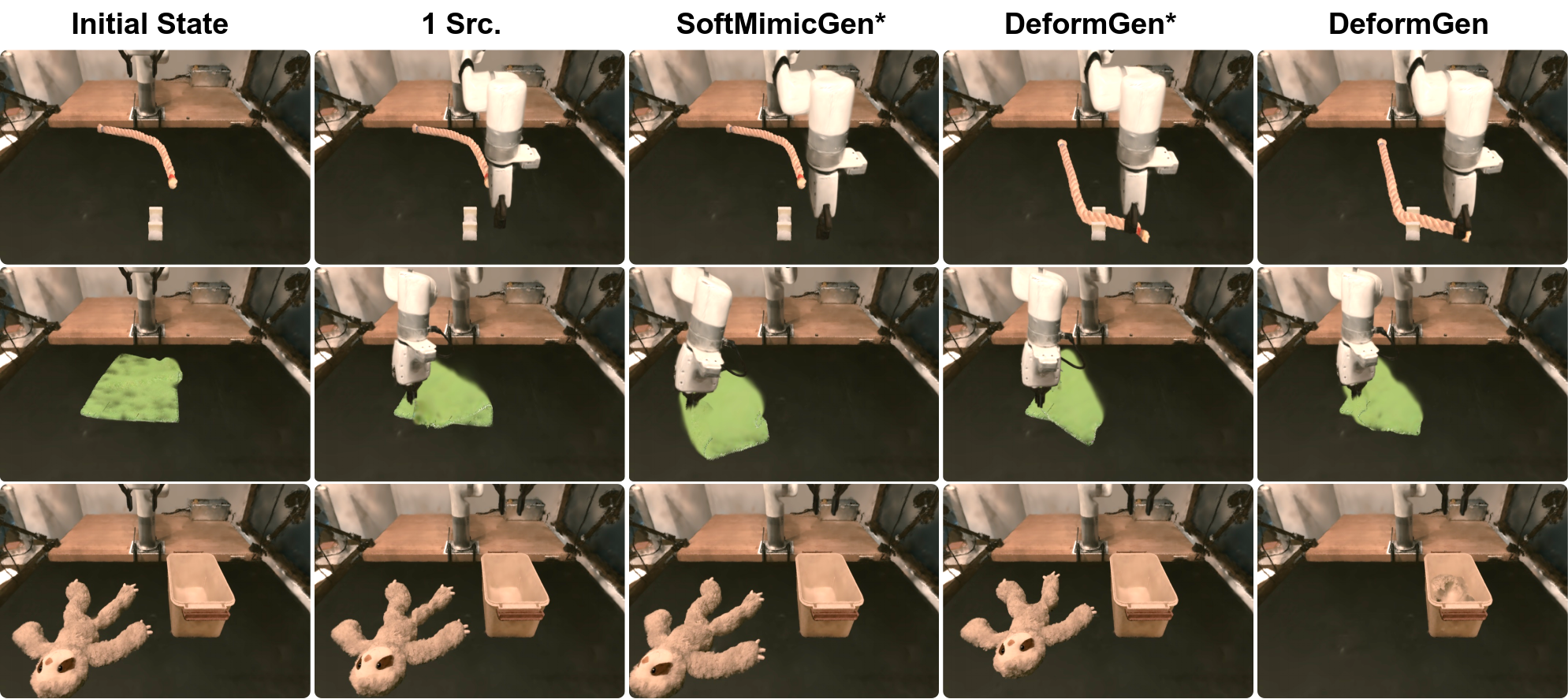
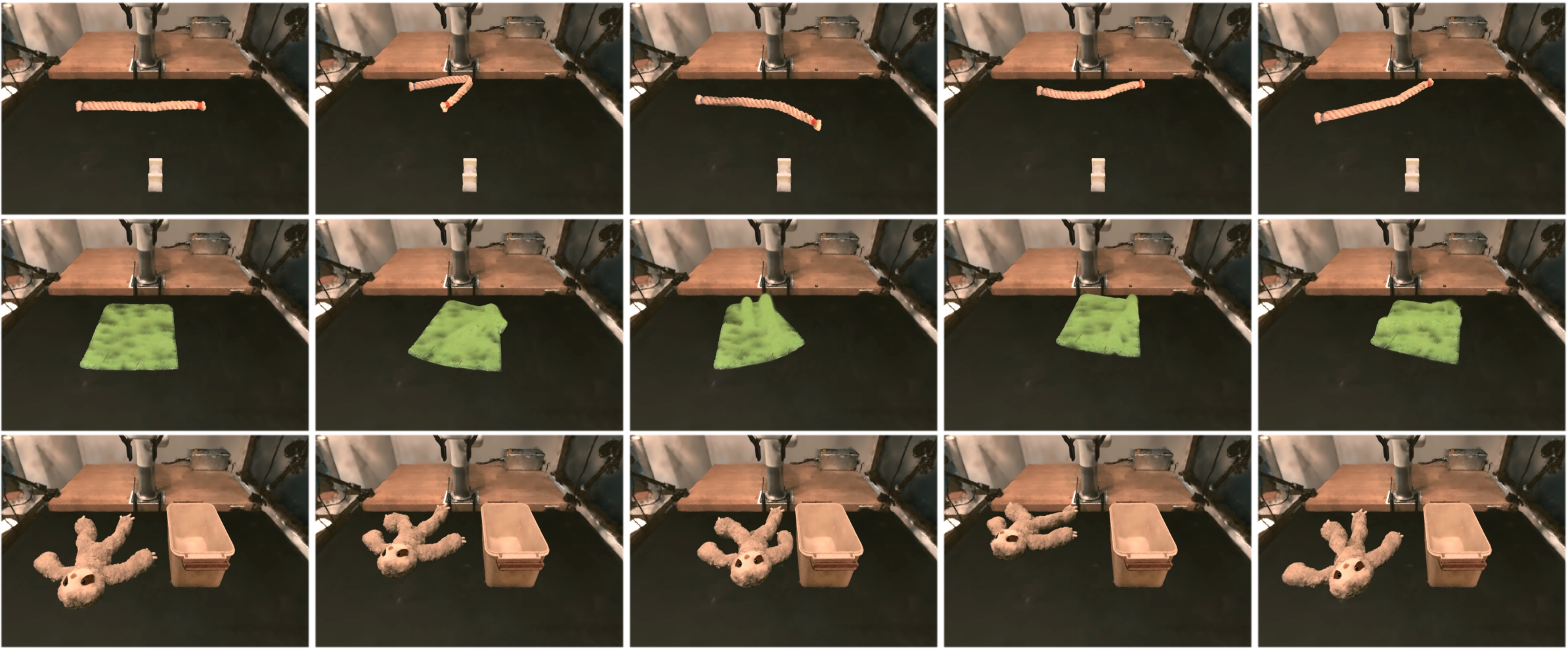
Qualitative comparison across tasks
Qualitative comparison across rope routing, toy packing, and cloth folding.

Policy Rollouts

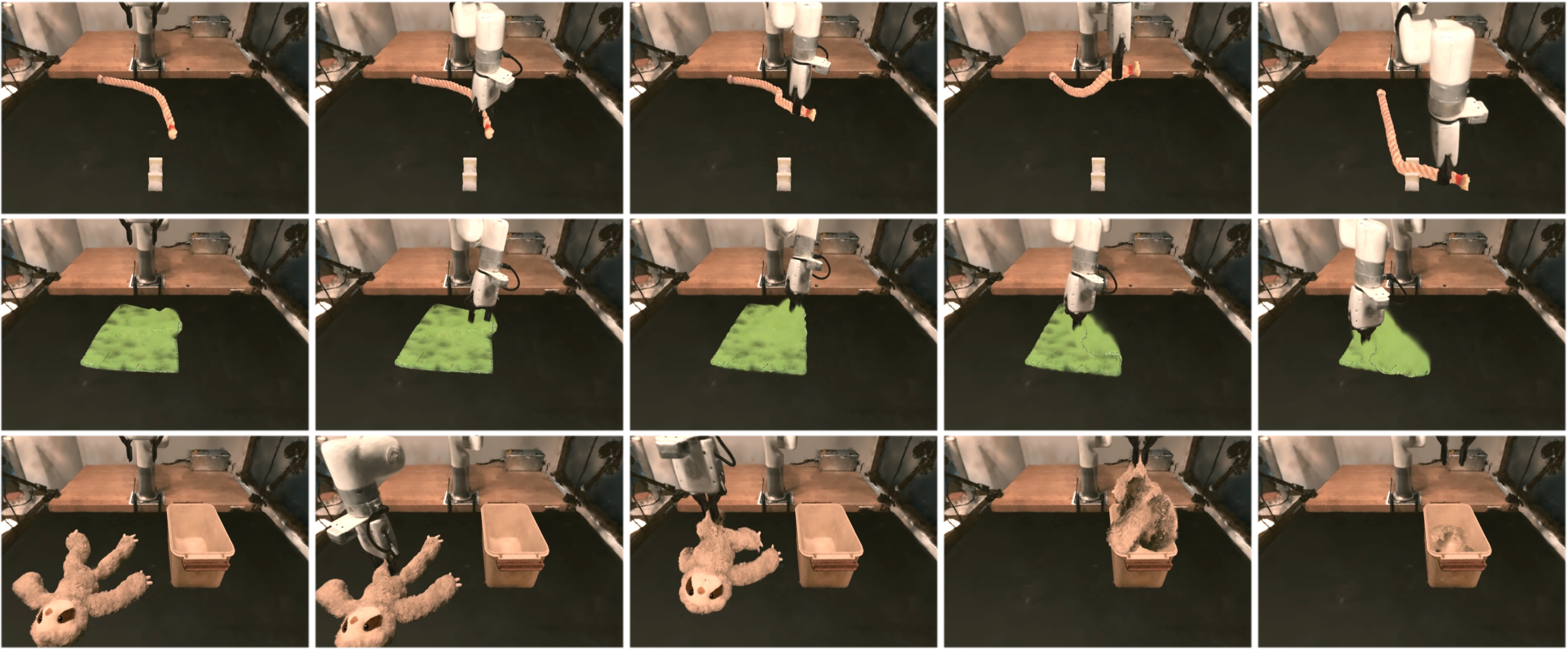
Generated supervision is validated through simulation replay before policy training.

Policy rollout examples on held-out states
Example rollouts on held-out deformable states.

Citation

@misc{lin2026deformgen,
  title={DeformGen: Dynamics-Based Topology Augmentation for Deformable Manipulation Policy Learning},
  author={Zili Lin and Wenyao Zhang and Yuyang Zhang and Zekun Qi and Junyan Lin and Hanxin Zhu and Jiaolong Yang and Zhibo Chen and Yao Mu and Xiaokang Yang and Xin Jin and Wenjun Zeng},
  year={2026},
  eprint={2606.25939},
  archivePrefix={arXiv},
  primaryClass={cs.RO},
  url={https://arxiv.org/abs/2606.25939},
}